Postdoctoral Researcher · Halıcıoğlu Data Science Institute, UC San Diego
Resource-efficient agents for science and engineering
AI agents can already generate work at scale. Turning that into real acceleration in science and engineering means accounting for what each step actually costs. I build the agents, the evaluations, and the benchmarks around that constraint. That instinct comes from particle physics, where every measurement is genuinely expensive and progress depends as much on engineering as on science.

Working principles
Research →- Evaluation before optimization. A score is useful only when its scope, methodology, difficulty, and lifecycle are understood.
- Representation shapes policy. Actions exist at different levels. How they are represented determines which policies can shape a trajectory—and what that trajectory costs.
- Workflows over prompt piles. Reusable capability needs workflows, specifications, and hooks, with room for users to plug in their own standards.
- Make the division of labor explicit. Humans own intent, judgment, and acceptance. Agents handle bounded execution and produce evidence both sides can use.
What I work on
Research →- 01Cost-aware agentic systemsClosed-loop systems that propose, implement, and evaluate experiments under real compute budgets.
- 02Scientific agent evaluationRepresenting decision trajectories and action spaces, so agents can be judged on outcomes and on what they spent.
- 03ML for scientific discoveryNeural processes and multi-fidelity surrogates for expensive simulation.
- 04Statistical inference at scaleBayesian and likelihood methods for rare-event searches, and the data systems behind them.
What I build
Projects →Major projects
-
02 · Methodology
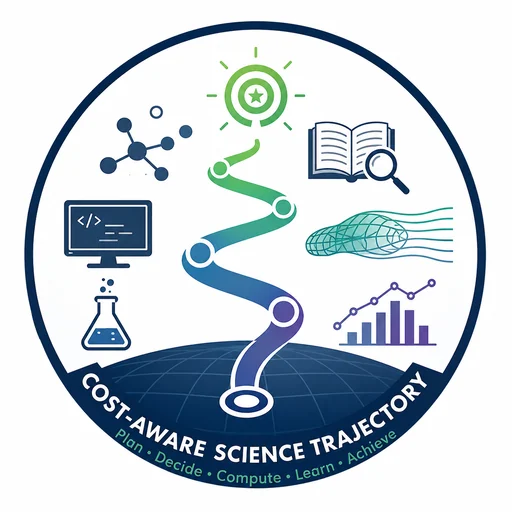
SciTra
Comparable scientific-agent trajectories, decisions, and resource use.
- scitra.org ↗
- Founder and Coordinator
Websites
-
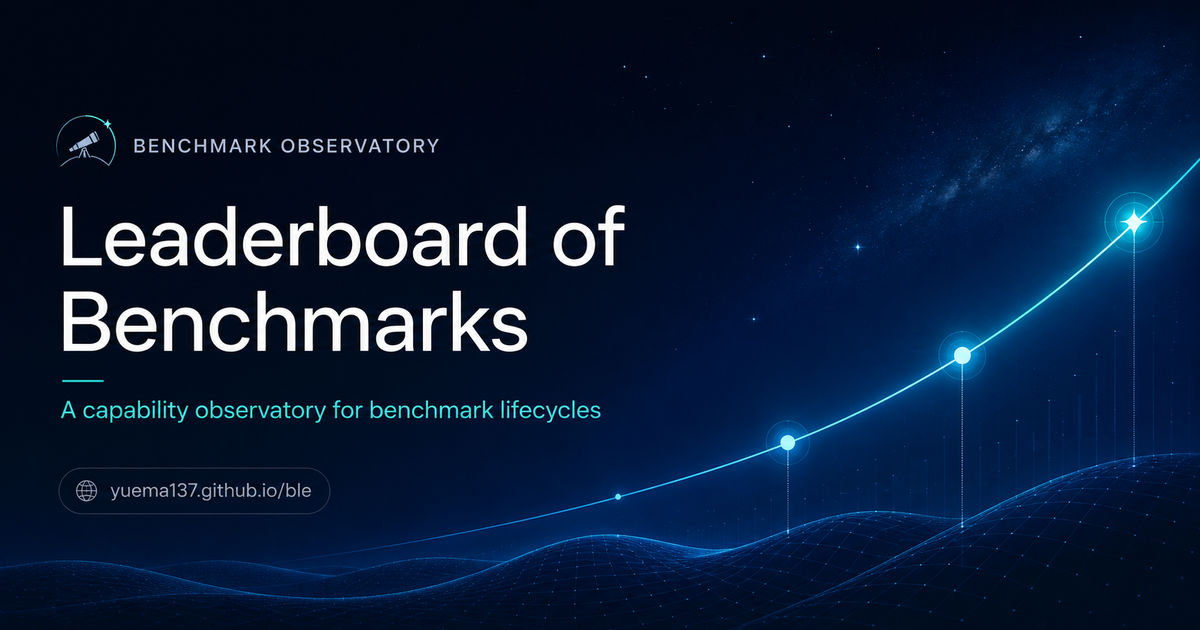
Benchmark observatory
Leaderboard of Benchmarks
Compare benchmark capability frontiers, coverage, and saturation.
-
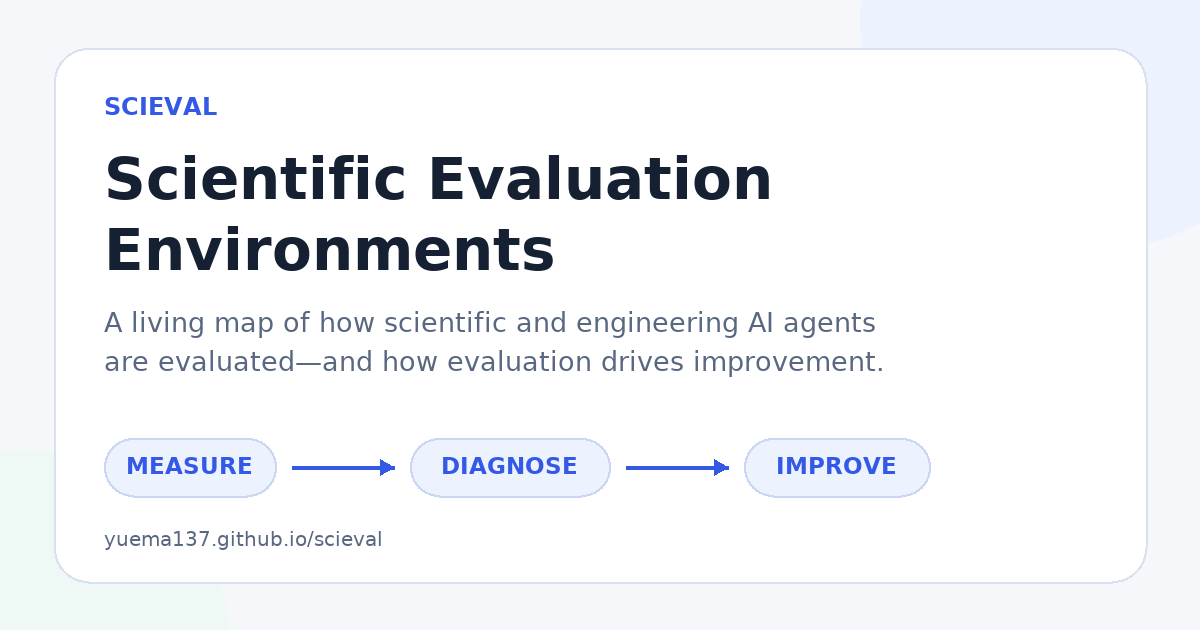
Living knowledge base
Scientific Evaluation Environments
A bilingual map of scientific-agent benchmarks and what their results reveal.
Small tools
-
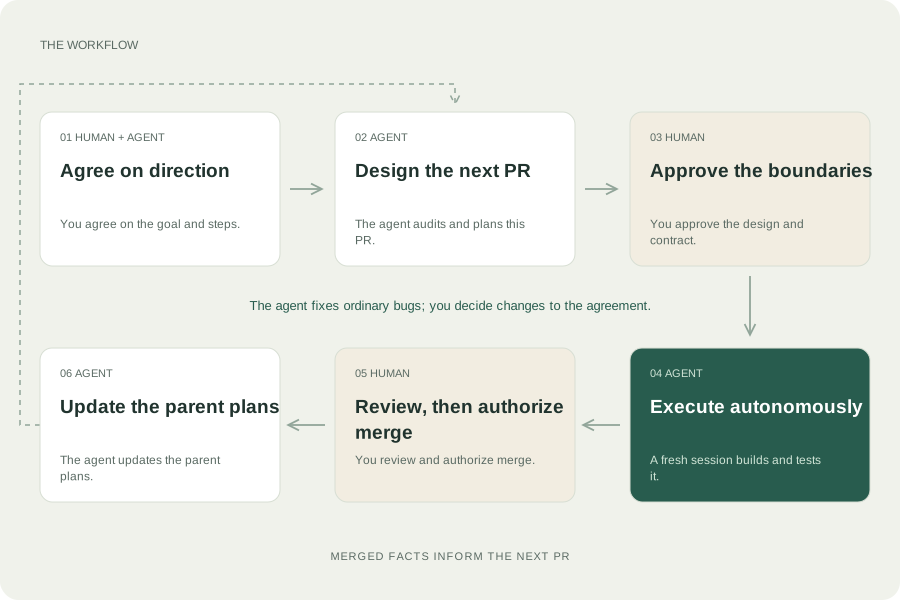
Agent workflow toolkit
Structured Coding
Agree on the change, build with evidence, and review one PR at a time.
Selected publications
View selection →- 2026 Beyond a Better Score: Long-Horizon Agentic ML Development and Evaluation Protocol for Physics Time Series Yue Ma, Lucas Venetoulias, Akbota Assan, Aobo Li · Submitted to ICLR · Preprint arXiv ↗PDF ↗Zenodo ↗
- 2026 First Measurement of Solar Neutrinos through Elastic Neutrino-Electron Scattering at the keV Scale XENON Collaboration (including Yue Ma) · Preprint Corresponding author · statistical inference, data processing, detector response modeling arXiv ↗
- 2026 Density-Guided Conditional Neural Processes for Detector Efficiency Estimation Yue Ma, Aobo Li · Machine Learning and the Physical Sciences Workshop (ML4PS) 2026 arXiv ↗PDF ↗
Talks
All talks →- 2026-09-04 LLM Agents for Science: Vibe Coding, Autonomous Scientists, and Beyond Fast Machine Learning for Science Conference 2026, UC San Diego · Birds-of-a-Feather session Programme ↗
- 2026-09-02 SIDERIUS: Resource-Aware Multi-Agent System for Automated Machine Learning Fast Machine Learning for Science Conference 2026, UC San Diego · Invited talk Programme ↗Slides ↗
Latest writing
All posts →- 2026-08 Verification, validation and metrics for autonomous vehicles Evaluating systems whose failures are rare, expensive and safety-critical. Read ↗
- 2026-01 Preparing for behavioural interviews without memorising answers Covering ~100 behavioural questions with four or five real stories. Read ↗