From STEM to AI: Skills, Research, and Career Paths
Recently, quite a few friends have asked me how to move from STEM into AI. Some are still studying and want to know where to start. Others have spent years in research and wonder how their knowledge and experience could carry over into AI work. I have been thinking about these questions myself and would love to talk them through with everyone. But there is rarely enough time for a detailed conversation with each person. So I decided to bring some of my thoughts and experiences together in this post.
My background is in physics, and I now work mainly on AI for Science. Along the way, I have been figuring out what to learn and which directions to explore. This post shares some of what I have learned so far. I have also collected job descriptions from industry to see what opportunities are available and which skills they involve.
Why I think this is a good time to start in AI for Science
One reason I started working on AI for Science is that LLMs have changed how we learn a new field. We can start with a concrete problem, ask follow-up questions when we get stuck, and build our understanding as we go. I think this creates a valuable opportunity for people who want to bring AI into a field they already know.
I want to distinguish two kinds of work here. The first is traditional AI for Science. The model we use in our research might not be a language model, but an LLM can help us learn the methods and get started. The second is research and applications built around LLMs themselves. In my view, these involve quite different ways of working.
Most of us do not have the computing resources to train a large language model from scratch. We are more likely to contribute through evaluation, post-training, or applications. These areas still require technical knowledge, but they give people with different backgrounds several ways to get involved.
In my experience, two things matter especially here: practical knowledge of the field and the application, and the ability to design systems.
By system design, I mean more than software architecture
Much of this involves designing software and agent systems. But I also mean something broader: when you face a complex scientific or engineering task, do you know how to carry it out? What problems might come up along the way?
That understanding often comes from doing the work yourself and building up experience over time. It can be hard to identify all the steps and pitfalls without having been through them. This is why I think our scientific training and practical experience remain valuable when we move into AI. They help us define tasks, design workflows, and judge whether a system has actually done what we need it to do.
How to start without an AI or agent background
I would split this into two questions. How do you start applying machine learning to scientific problems if you have never worked in AI? And how do you get started with LLM agents? There is some overlap, but each calls for a slightly different focus.
AI for Science: learn to match models to problems
If you want to apply machine learning to science, I would start with model architectures, the structure of your data, and the scientific problems worth solving. You may be coming from a field outside ML engineering or research on general-purpose models. A useful starting point is a scientific problem you understand, where you can see how machine learning might help.
An important skill here is recognizing when a class of models fits a class of scientifically meaningful problems. I think of this as research taste. It means understanding both the method and the problem: how the model and data are structured, why they fit together, and what solving the problem would contribute.
If you are starting out, I would organize your learning around these connections. Your experience in a field can help you judge which questions matter. The next step is to understand models and data well enough to connect them.
LLM agents: bring the tools into your daily work
If you have no experience with LLM agents, I would not worry too much. The tools are available for us to use, and most of us have never trained the frontier models behind them either. We can start by using them, gradually learn how they work, and then try improving them. We can choose where to focus based on the resources and experience we already have.
My first suggestion is to use existing tools more often in your daily work: Codex, Claude Code, and Google's Antigravity, for example. You could also explore projects such as OpenHands, Pi and OpenCode, and agent orchestration frameworks such as LangGraph. I think they are all worth learning from. Exploring their features, structure, and design choices is interesting in itself.
Pay particular attention to agents and research built for scientific tasks in your own field. You do not have to try every system yourself. But try to understand its design: why is the work organized this way? What might it do well or poorly? Where are the bottlenecks? Understanding those choices matters more than simply recognizing a tool's name.
From using to improving: decide what “better” means
My second suggestion is to think about how you could improve these tools as you use them. First, you need a way to tell whether a change helps. That leads to a difficult and important question: how do we turn a feeling that something works well or badly into something we can measure and compare?
Humanity’s Last Exam (HLE) and Agents’ Last Exam (ALE) illustrate this well. HLE collects difficult questions across disciplines and tests whether models can answer them correctly. ALE focuses on real professional workflows. Developed with more than 250 industry experts, it covers over a thousand tasks across 13 industry clusters and 55 subfields. Agents must carry out work over multiple steps and produce results that can be checked.
These examples show how the abilities we evaluate change with the task. For a question, we mainly check the answer. For a job, we also need to see whether the agent can plan the steps, use tools, handle problems along the way, and deliver the result we asked for. I have collected more scientific and engineering evaluations on my SciEval website. You might find tasks there that relate to your own field.
There are many concrete questions here. What counts as useful exploration? Suppose an agent runs ten experiments without improving the metric, but rules out a mistaken hypothesis and shows us that we should change direction. Was that exploration valuable? Conversely, if it repeatedly tries similar approaches and occasionally finds a better result, how should we judge its ability to explore?
Cost-effectiveness also depends on the task. Two agents might reach similar results, but one takes ten minutes and the other several hours. Some consume more tokens; others require expensive simulations or GPU experiments, or repeated human corrections. We can compare what they achieve under the same budget, or the resources each needs to reach the same goal. Whether doubling the compute is worth a small improvement depends on what the task calls for.
Another question I find interesting is which steps really matter during a long task. An agent might discover a problem in the data, choose the right validation method, or revise its plan after an experiment fails. It may then write a lot of code and make many tool calls, even though the outcome depends on that earlier judgment. How can we identify those key steps and measure their contribution? What happens if we change one of them? These are worthwhile research questions, and the answers could help us decide which part of an agent to improve next.
Why scientific and engineering experience helps with evaluation
Recent progress by LLMs in mathematics has been striking. OpenAI has released model-generated draft proofs addressing the Navier–Stokes problem, one of the Millennium Prize Problems, as well as questions related to the Kakeya conjecture. Its October release alone contains more than seven hundred mathematical research manuscripts. Seeing this progress naturally raises a question: how far can LLMs go in other areas of science and engineering?
I think the important point is that different fields have different difficulties and bottlenecks. Mathematical reasoning matters, but a scientific or engineering task may also depend on understanding the data, experimental conditions, and practical workflow. We need to check each ability: can the model derive a result, detect a measurement problem, judge whether an approximation applies, or reproduce an experiment? This is where STEM training and hands-on research experience can be especially useful.
Many mathematical proof tasks have a clear target: does the argument hold under the stated definitions and assumptions? If the proof is complete, a reader can follow and check the reasoning. Scientific and engineering research often involves a great deal of practical detail. Even a carefully written paper can leave a gap between understanding the work and reproducing the results. Some of this comes down to documentation. Some comes from the difficulty of describing and quantifying the task itself.
People who have done scientific and engineering work themselves are better placed to notice missing details, recognize results that need further checking, and judge what counts as meaningful success. I think that experience can help us build tasks and evaluations that reflect real work.
I hope to see LLMs become more useful in practice and help us move faster on scientific and engineering tasks. There is still a large gap between the abilities a model demonstrates and the reliable help it can provide in real work. Much of that potential remains untapped. To me, that is part of what makes this area worth working on.
From STEM to AI: which roles are worth exploring?
If we want to move from STEM into AI, where can our research experience help, and what skills do we need to add? With these questions in mind, I collected 841 job postings from 108 companies and analyzed the skills they involve. I focused on roles that people with a STEM background could work toward through further learning and projects. I wanted to find concrete ideas for what to learn and build next.
The companies include big tech, AI labs, application startups, and AI for Science teams. The table below shows their breakdown as of 30 October 2026. The charts compare US and worldwide roles: 611 postings from 92 companies in the US, and 841 postings from 108 companies worldwide. The worldwide group includes the US.
| Category | US | Worldwide (including US) |
|---|---|---|
| Big tech / public companies | 31 | 31 |
| Unicorns | 43 | 49 |
| Other startups | 18 | 28 |
Understanding what a role actually involves
When you first look at AI jobs, you may come across a long list of unfamiliar technical terms. I would start with the work itself: what problem is the team trying to solve? What would you actually do there? Two roles might both mention evaluation. One might focus on designing experiments and analyzing results; the other might involve building software that runs evaluations continuously. Once you understand the work, it becomes easier to see where your experience would help and what you might want to learn next.
Skills that appear in these roles
| Skill area | What it involves |
|---|---|
| E · Evaluation | Model or agent quality measurement, benchmarks, graders and failure analysis |
| H · Agent harness | Agent execution, tools, environments and orchestration |
| P · Post-training | Fine-tuning, preference optimization and other post-training methods |
| M · ML modeling | Model or algorithm design, research and training |
| S · Systems | Production systems, serving, distributed execution and data infrastructure |
| D · Domain expertise | Specific scientific or technical domain knowledge |
| T · Statistics and experiments | Sampling, uncertainty, controlled experiments and reproducibility |
| R · RL and rewards | Reinforcement learning, reward design and policy optimization |
These skills often come together in practice. Building an evaluation platform, for example, involves designing tasks and metrics, processing data, running experiments, and recording results. Systems work includes data pipelines, model deployment, and multi-GPU inference optimization. You could choose one of these areas to explore in depth, based on your experience and interests.
Which skills show up in the work?
Looking at these roles together, some skills come up repeatedly. The chart below offers a starting point for choosing what to learn. You can then look more closely at individual roles to find work that connects with your experience and interests.
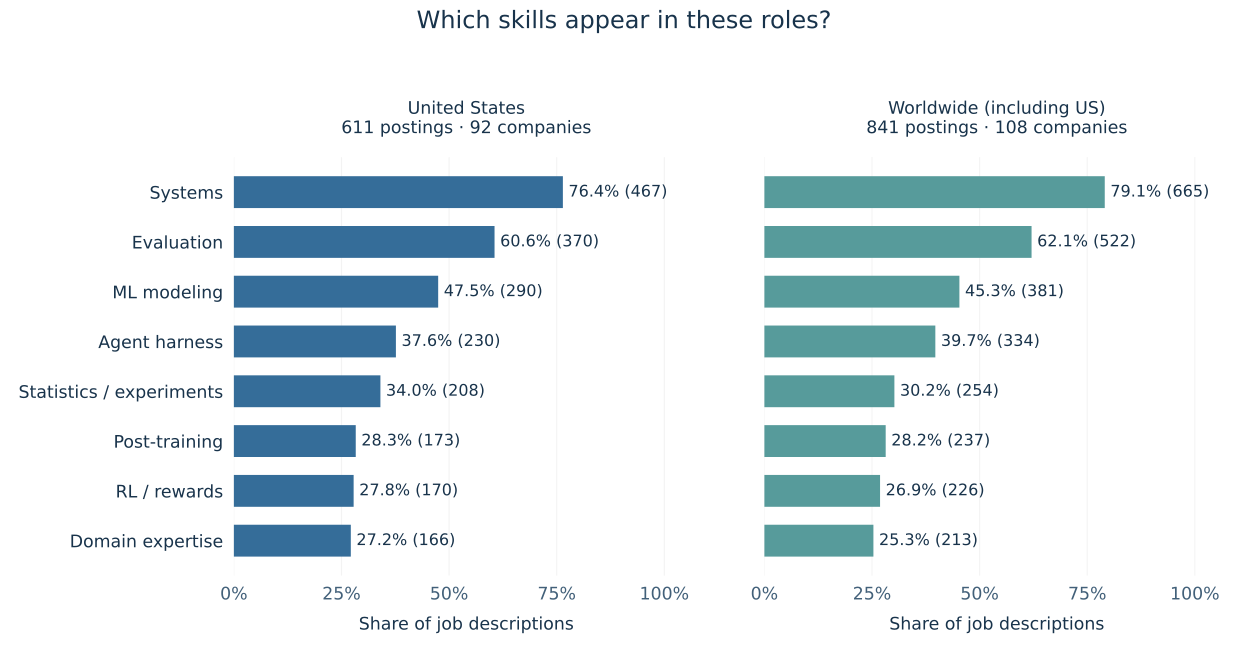
Systems and evaluation appear most often in both groups. They feature in 76.4% and 60.6% of US postings respectively, compared with 79.1% and 62.1% worldwide. Evaluation also often appears alongside systems work. Among the 220 US roles that mention evaluation but not post-training, 159 involve systems. This connects two things we discussed earlier: judging how well AI is doing and building the workflow that lets it do the job.
| Skill combination | US | Worldwide (including US) |
|---|---|---|
| Evaluation present | 370 / 611 · 60.6% | 522 / 841 · 62.1% |
| Post-training among evaluation postings | 150 / 370 · 40.5% | 201 / 522 · 38.5% |
| Systems among evaluation postings without post-training | 159 / 220 · 72.3% | 245 / 321 · 76.3% |
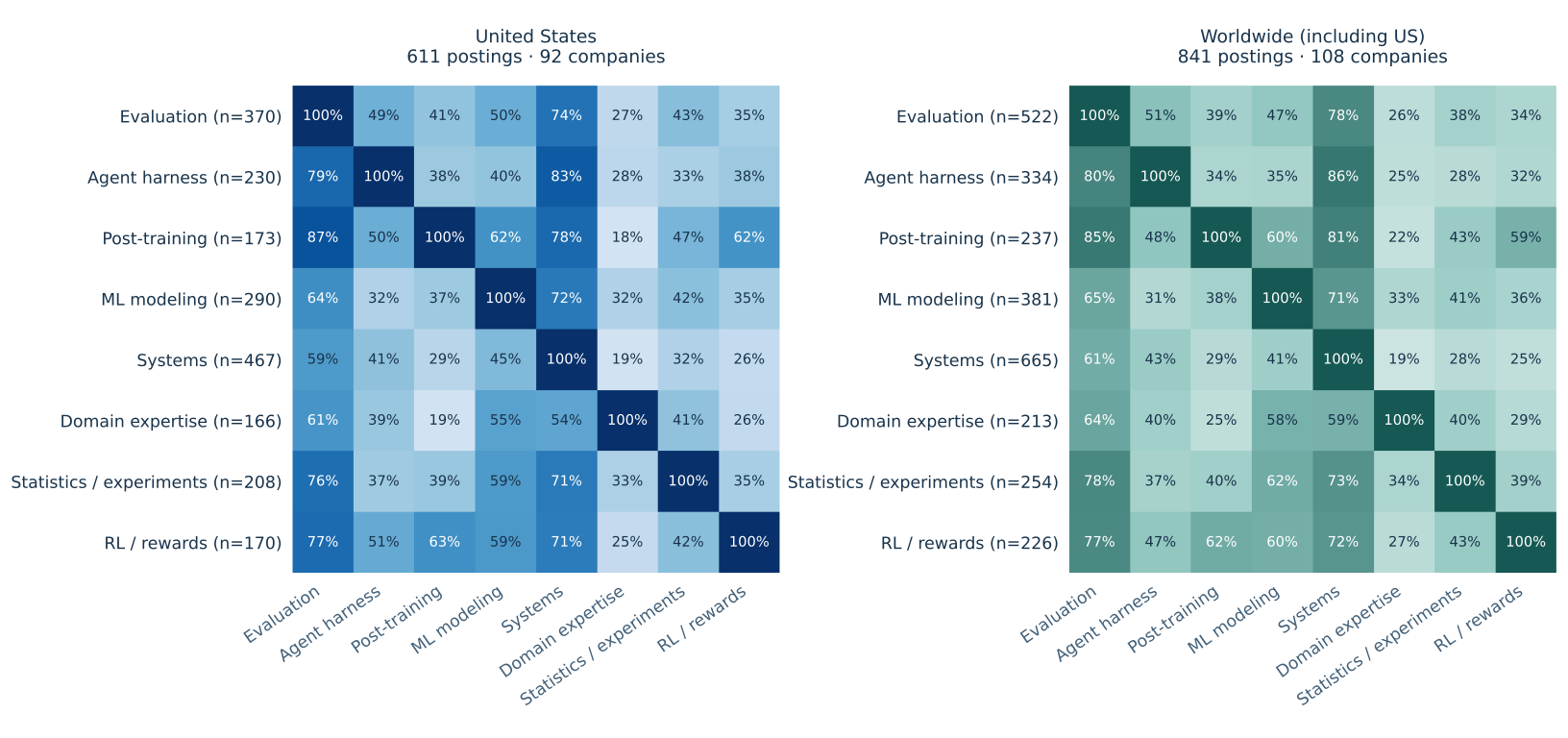
Types of AI work and the skills they involve
Evaluation and applied data science
I think evaluation and applied data science are worth exploring if you have experience in quantitative research. When a model is updated, has it actually improved? Do the questions in an evaluation reflect what users encounter? If a score goes up, how can we tell whether the improvement comes from the model or from the choice of test data? These questions call for statistical analysis, experimental design, and an understanding of the task itself. They have quite a lot in common with the work we do in scientific research.
If your research already involves processing data, designing controlled experiments, or analyzing errors, this could be a useful place to start. You could learn more about LLM and agent evaluation, then turn your analyses into tools you can run repeatedly. The question we discussed earlier—how to measure whether something works well—becomes very concrete in this kind of work.
Microsoft’s Senior Data Scientist for Copilot Evals is a good example. The role asks whether evaluation sets cover real user needs, whether automated grading is reliable, and whether better offline test results translate into a better experience with Copilot. Statistical and experimental skills help the team assess product quality and decide what to improve next.
Agent and research tool development
Another type of work connects models, tools, and experimental workflows so that AI can carry out complex tasks. An agent might propose a code change, compile and test it, measure its performance, and use the results to improve its next attempt. This brings us back to system design. How should the task be broken down? How should tools be called and intermediate results stored? How should work resume after a failure?
If you have done scientific computing or built experimental and data-processing workflows for your research, this is a direction you could explore further. Programming, software structure, and debugging matter here, alongside agent tool use, state management, and evaluation. As tasks grow, parallel execution, resource allocation, and running costs become part of the work too.
AMD’s ML Systems Research Engineer, RL / Inference / Agent Systems (92704) is one example. Some of the engineering tasks it supports take minutes or even hours to validate. The work involves generating candidate solutions, organizing validation, recording experimental results, and returning useful feedback for the next attempt. Experience with scientific computing and experimental workflows can be valuable in building these systems.
Model research and scientific applications
If you enjoy studying models, or want to use machine learning to solve problems in a field you know, model research and scientific applications are worth exploring. The work often involves model architectures, training methods, data organization, and experiments to test an idea. The research taste we discussed earlier matters here: understanding the problem, deciding which models to try, and investigating why they succeed or fail.
This direction calls for a solid foundation in machine learning and the ability to implement and modify models in frameworks such as PyTorch. For scientific applications, domain knowledge matters too. You need to understand how the data was produced, which rules and constraints should be considered, and what would make a result meaningful in that field.
SAP’s Senior AI Researcher – Relational Foundation Models (REF2073B) offers an example in structured data. The role studies how models can learn from multiple related tables and adapt to different prediction tasks. The work includes designing architectures and training objectives, running GPU experiments, and comparing results through baselines and ablation studies. Its use of Transformers, graph learning, and relational data modeling suggests a concrete way to learn: start with a data structure you understand, then explore methods suited to it.
How to Start Your First Project
After all these possibilities, we come back to a practical question: what can you do first? My suggestion is still to start with a field you know. Read a few relevant papers to see which problems people care about and which methods they have tried. Then consider whether a model or agent could help with a specific part of your research. You might try an existing model on familiar data, or turn a repeated analysis or simulation workflow into a task an agent can carry out. As you work, you will get a clearer sense of what you need to learn next.
Start with a workshop paper or an open-source project
If you want to pursue research, you could start by aiming for a paper at a relevant workshop. Choose a focused problem, reproduce an existing method, and try to improve it. Write up what you observe and the questions that remain. This can help you learn how AI research is done and meet people working on similar problems.
If you build a tool, you can put it on GitHub. Explain the problem it solves, provide an example someone else can run, and invite friends in your field to try it. The difficulties they encounter will often reveal things you had not noticed. If the tool helps them, you can keep improving it and see whether it works for a wider range of tasks.
I think what matters is doing work that has an impact. Papers, open-source code, and tools that people use are all ways to share your work and show others what you are doing. Making an idea concrete and sharing it early helps you get feedback and find directions worth pursuing.
Work with people whose backgrounds complement yours
Another practical suggestion is to find students or friends with AI or CS backgrounds who are interested in AI for Science. You understand the scientific problem, where the data comes from, where existing methods struggle, and whether a result is meaningful. They may know more about models, training methods, and software implementation. Read a few papers together, choose a problem you both care about, and start a small project. It can be a good way to learn from each other.
It is also worth taking time to understand how your collaborators think. Why choose this model? What does this experiment tell us? Which scientific conditions affect the design of the method? These conversations can help you connect your domain experience with new techniques and develop your own judgment.
Learning about a new field is much easier than it used to be. You can work through unfamiliar concepts with an LLM or use a coding agent to start trying a method. So it is worth starting these explorations early. By learning as you work on real problems, you can gradually find what interests you and what you want to keep pursuing.
Company coverage and source notes
The job descriptions come from company career sites and public recruiting platforms. Agents helped collect, read, and organize them. As of 30 October 2026, the worldwide analysis covers 841 postings from 108 companies. The US subset covers 611 postings from 92 companies. The companies are listed below:
Aaru · Abridge · Adobe · Affirm · AI21 Labs · Airbnb · Aleph Alpha · Alphabet · AMD · Anthropic · Anyscale · Arthur AI · AssemblyAI · Baseten · Block · Braintrust · Cartesia · Chai Discovery · Cognition · Cohere · Confident AI · CoreWeave · Crusoe · CuspAI · Databricks · DatologyAI · Decagon · Deepgram · Duolingo · Dynatrace · ElevenLabs · Factory · fal · Figure AI · Fireworks AI · Generate Biomedicines · Genesis Therapeutics · Glean · Goodfire · Gray Swan AI · H Company · Harmonic · Harvey · Iambic Therapeutics · idler · Instacart · Labelbox · LangChain · Latent Labs · Lightning AI · Lila Sciences · Liquid AI · LlamaIndex · Lyft · Magic · Mechanize · Mercor · Meta · Microsoft · Mistral · Modal · MongoDB · Nous Research · NVIDIA · OpenAI · Oracle · Oratomic · Orbital Materials · Owkin · Patronus AI · Periodic Labs · Perplexity · Physical Intelligence · PhysicsX · Pinterest · Poolside · Prime Intellect · Profluent · Prolific · Qualcomm · Ragas / Vibrant Labs · Recursion · Reddit · Reflection AI · Reka AI · Roblox · Runway · Sakana AI · Salesforce · Samsung Research · SandboxAQ · SAP · Scale AI · ServiceNow · Skild AI · Snorkel AI · Snowflake · Sourcegraph · SpaceX · Spotify · Thinking Machines · Toast · Together AI · Turing · TwelveLabs · V7 · Vals AI · Writer